


With the widespread application of endoscope products, what technical parameters should people pay attention to when choosing suitable endoscope products, among which lens is the most core part. The focal length, depth of field and Angle of view of a lens are three basic concepts, which are closely related. The following will explain these three concepts in detail.
First, the focal length of a lens refers to the distance between the lens and the object. The focal length is a fixed physical size and does not change with the camera's frame. The smaller the focal length, the greater the magnification, and the clearer the detail. On the contrary, if the focal length is too large, there will be blurring or distortion. Therefore, when using the endoscope, we need to choose the right focal length according to the actual needs, to ensure the best observation effect.
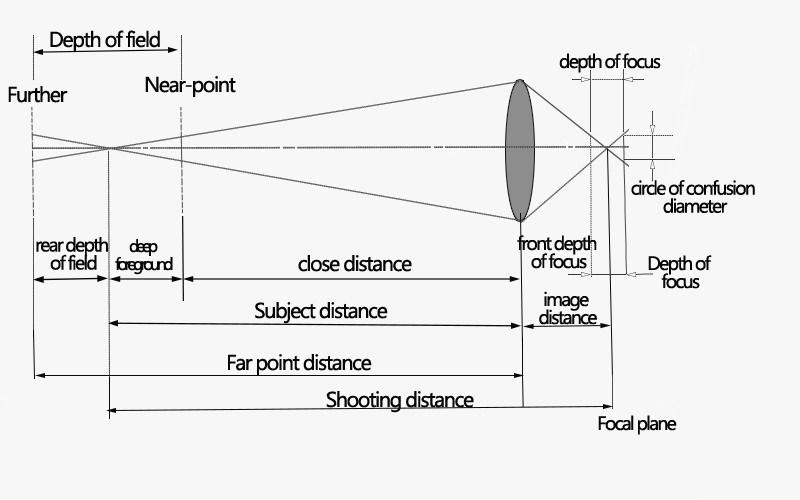
Second, depth of field refers to the extent to which the object captured by the lens appears clearly on the plane where the lens is located. The mirror is the so-called "virtual-real dividing line." The depth of field is related to the focal length, aperture and object distance of the lens. When the focal length and aperture are larger or the object is far away, the depth of field is larger and can show a wide range of objects; otherwise, the depth of field is small and can only show a very small range clearly. This is also the reason why the focal length and aperture should be adjusted frequently in endoscopy. The longer the focal length, the smaller the depth of field, and the shorter the focal length, the smaller the depth of field.
Finally, field Angle is an essential feature of a camera. It refers to the range of horizontal or vertical angles that can be covered by the lens. Generally speaking, the larger the field Angle, the wider the range of the scene captured by the camera, and the larger the viewing Angle. On the contrary, when the field Angle is small, the range of the display will be very narrow, and only a very small range can be clearly displayed.

The focal length, depth of field and Angle of view of the endoscope lens are interrelated, which jointly affect the observation effect of the endoscope. If we can achieve clear and accurate observation, we need to adjust and configure these parameters reasonably to achieve the best observation effect. At the same time, with the continuous development of technology, the lens of the endoscope continues to evolve, which also provides more guarantees for us to better look inside the object.


